
The data of drama
To see or not to see: Which character has the most lines on stage? Which playwright uses the most stage directions? Questions like these can be answered by the database developed by Ingo Börner and his team. (© Oscar Giraldo/shutterstock)
Ingo, you and your colleagues are working on a so-called programmable corpora. Can you tell us more about it?
We are developing a prototype for a platform—DraCor—which enables researchers to carry out digital literary analysis on a large set of dramatic texts. It includes of course a database and, above all, an application programming interface (API). Our goal is to ensure that as many researchers as possible have access to high-quality data and tools with which they can analyze digital dramatic texts. We use digital data that is encoded according to the guidelines of the TEI, the Text Encoding Initiative. Furthermore, we use versioning, which makes it possible to have the kind of living corpora we aim to achieve. We are constantly working on it, adding new texts. Via GitHub our users can go back in the version history and call up the corpus in its form at a certain point in time.
Why is that so important?
As in many disciplines, a big challenge in the field of Computational Literary Studies is the reproducibility of research. To achieve it, the data must of course be prepared accordingly. But many results are not documented properly and as a consequence the research cannot be repeated—especially in cases like ours where the corpora are constantly growing. What we are working towards is the stabilization of these corpora. In other words, a researcher who wants to repeat an experiment has the opportunity to go back in history, and then find the relevant data as it was found by the team who carried out the analysis for the first time.
How do you implement this?
We rely on Docker technology and don’t just apply it to our corpora, but also to all the other components that play a role in our system. We make images of all these Docker containers available so that even if we continue to work on the data or the software, there is still the possibility of going back in time via these images and working with the data and with the tools as they existed at a certain point in time.
That sounds great, but also quite complex. How IT-savvy do researchers have to be to use this platform?
Of course, we also think of beginners in the field, of students who perhaps don't have that much experience with such technology. We also want to enable them to work with these methods and produce reproducible research. However, to simplify this process of Dockerization to such an extent that students can also implement and carry it out, is actually quite a challenge for us.
The platform was initially developed in 2018. What impact has it had on your field so far?
We are observing that our corpora as well as our methods are being used increasingly. We were particularly happy to see that in the volume published alongside a conference on digital drama analysis last year a majority of authors have used one or the other corpus from the DraCor platform. It makes us very proud to see that the number of research publications that use DraCor is constantly growing and we collect them on our website in a designated section. These contributions are more and more from people outside of our core team here at Potsdam University which shows that the popularity of our service is growing.
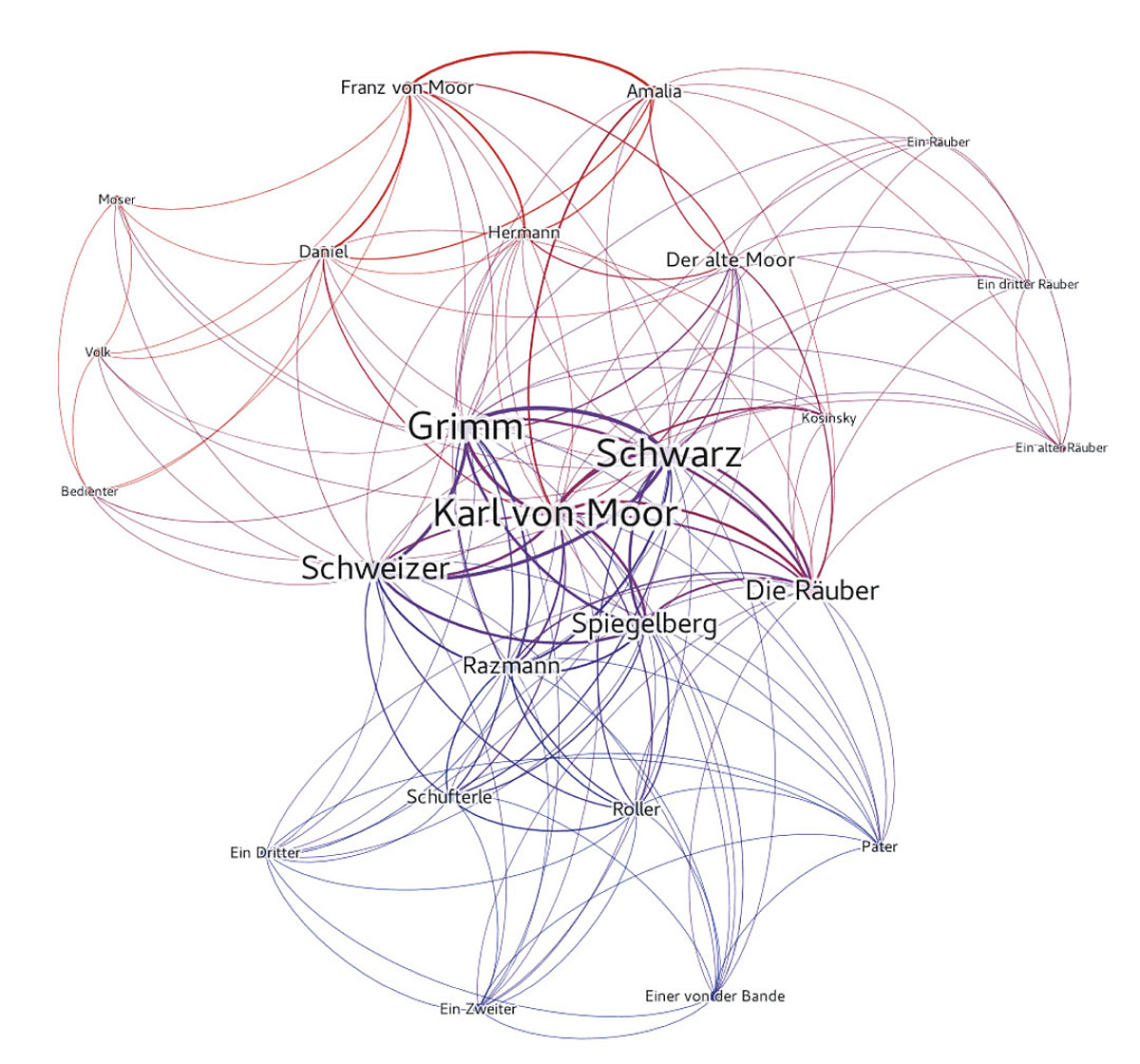
This graph shows just how complex plays can be in terms of the relations between the different characters. (© DraCor)
Ingo Börner and his team have already seen quite a number of publications using their database. (© Ingo Börner)

“Of course, we also think of beginners in the field, of students who perhaps don't have that much experience with such technology. We also want to enable them to work with these methods and produce reproducible research.”
Ingo Börner
What is the specific benefit this platform can bring to the field of literary studies, specifically drama analysis?
Plays are usually structurally very complex texts: There are characters who speak in dialogue or monologue, but there are also stage directions, which are part of the full text. In an analysis, it is often necessary to look at those separately. Our API makes it possible to output only stage directions or only the spoken words of female characters within a piece or a whole corpus. You can imagine that there are some very interesting insights to gather from a search applying such criteria. But in order to do that, these criteria need to be properly annotated in the data and then also implemented algorithmically in the software, to make it queryable via the API. But if we follow these guidelines, we can stabilize epistemic objects that are fundamental for digital drama analysis.
What are challenges you still haven’t tackled in your work on DraCor?
We are of course constantly learning how to manage our data. But other than that, there is one question for which we haven't yet found the ideal solution: How can we guarantee the long-term availability of our data? GitHub is a widely used and suitable tool but using it means that we are dependent on a provider we have little to no control over. There are already projects in the NFDI circles which develop repositories that would meet our needs but as of now I think we might not yet be at the point of the research data management cycle where we can actually deposit our finished corpora in one repository. But that is certainly something that will happen sooner or later and we will take a close look at what options we have to make the data available and maintain it in the long term. Another, perhaps even bigger challenge than archiving data is doing the same with software as well as interfaces.
How so?
With DraCor in particular, the front end of the platform plays a crucial role because it is the access point for beginners in the field and perhaps also for specialist scientists who do not necessarily want to work with an API. We have this front end that offers a lot of functionality, especially the possibility of downloading the texts in different formats so that they can be edited with open source tools, including network data, for example, and software that can be archived and made available in the long term. We hope that we can preserve it through the containerization with Docker technology. That way, there is at least the possibility of different versions which can be run locally with the appropriate data, so to speak, for example to reproduce past research, but also to do own research and do it in such a way that at least I as a researcher have the opportunity to fully control my research environment and have it running again at any time.
With so many aspects to consider, there must be a lot of different people involved in the project.
Absolutely. Our work on this platform is a very collaborative process. We have a lot of people who are not part of the core team, who basically don't develop the platform, but provide essential data or look after the corpora. So it's not just about making the tools available, but there's a lot of training involved. Of course, we provide the respective guidelines but I think a key takeaway is that it’s often not just technology that counts in research data management. Community building also plays a crucial role.
Ingo Börner
is a researcher at the University of Potsdam and is involved in the development of DraCor, a platform for digital drama analysis. He specializes in digital literary studies, data modeling, and text encoding. Börner focuses on using computational methods in literary research and improving digital tools and infrastructures for international projects.
Follow-up
About the project
DraCor is a platform that helps researchers analyze drama texts digitally. It provides a database and tools to study specific text elements like stage directions or dialogue. By using versioning and Docker technology, the platform ensures reproducibility, allowing researchers to access previous versions and making it a key resource for digital literary studies.

